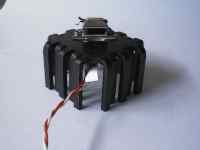
Peltier cooling device test:
How did i made the test ?
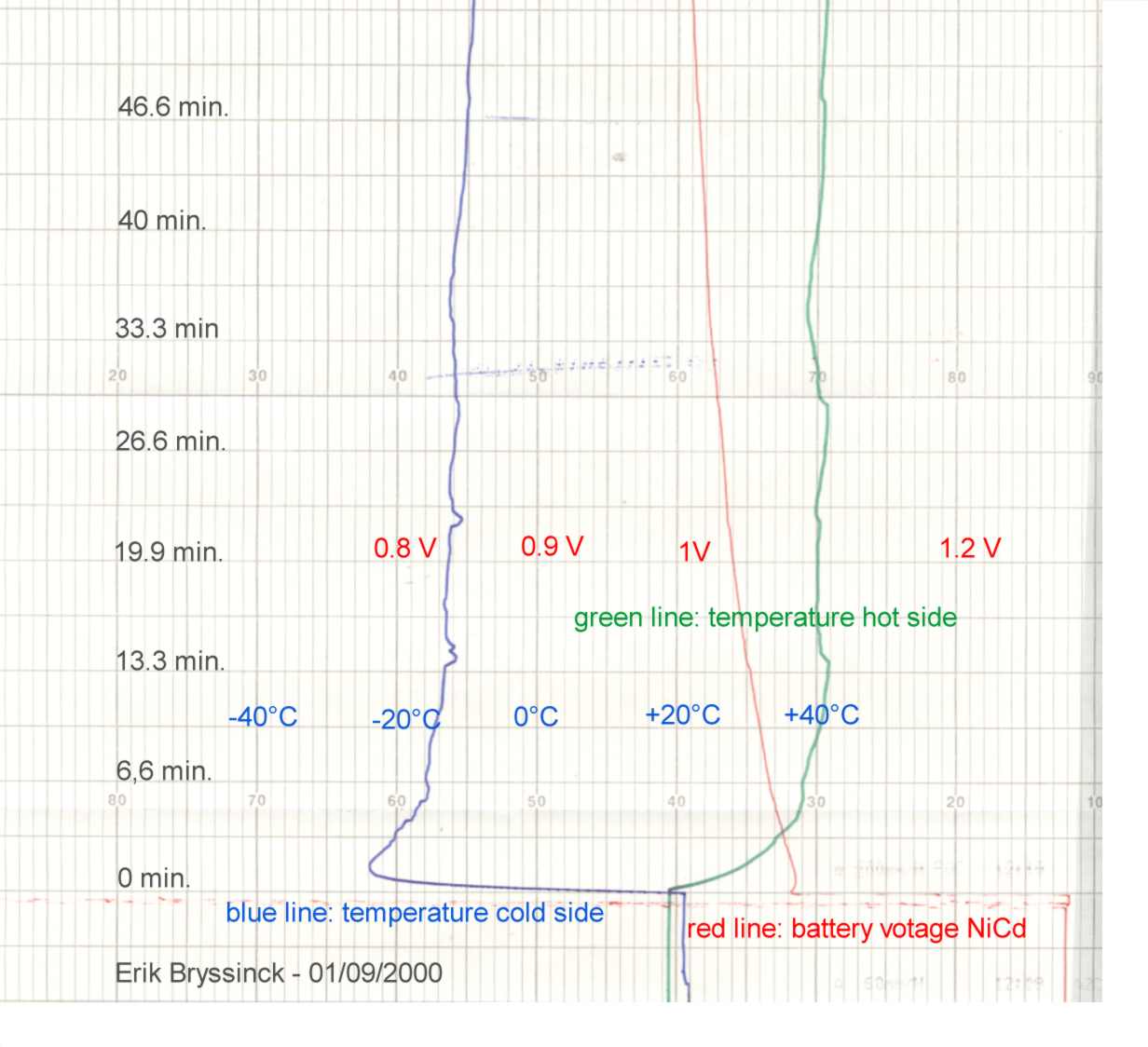
I mounted 1 Pt100 temperature sensor on the cold side of the cooling device.
On the hot side i have mounted the Peltier on a heat sink that normal is designed for a transistor.  On the hot side i mounted a second Pt100 temperature sensor.
Both temperature sensor are recorded on a chart-recorder with scale of -50 to +50 degrees Celcius.(0-100% on the paperchart)
On a thirth channel i measured the voltage of one NiCd-battery of 1.2V 4000 mAh.(red line on the chart of the recorder) scaling: +500 mV to 1500 mV (0-100%).
Conclusions of the test
© Erik Bryssinck - 09/2000
©
  • We must wait about 10 minutes before using our CCD camera.
  • The hot side of the Peltier device is going to +20° higher then the ambient.  Which means that the heat sink must be increasing.  We must choose a heat sink for a increasing temperature of the hot side from 5 to +15°C of the ambient temperature.
  • power supply: we can work work with one NiCd battery for aprox. 1 h. We don't may unload the battery to low, this would damage the NiCd battery.  We must considdering to continu measure or made a alert when the battery voltage is going to low.
  • We can cooled to -30°C of the ambient temperature, which is very good for one Peltier device.  Normally is this ok, considdering the operating temperature range, given bij the manufacturer of the CCD TC255P chip, from -10 to +45 °C.
  • When the hot side is going down in temperature, the cold side is going down.  So we must have a very good transfer from the surface of the heat sink into the surroundings. We can extra cooled the heat sink bij water or a small fan. Water is not very practically but it gives  the best result, a small fan is  is lower in cost and is more practical in the field. So we can make a heat sink with both cooling systems fan and water cooling.
  • By the start wa have a voltage of 1.1 V of the NiCd battery and an delta-T of 52°C.  After 45 min. working we have a voltage of aprox. 1V and a delta T of 50°C.